


ARCHITECTURE DESIGN STUDIO 4 [ARC 2126]
Project 1 Green Info Shelter: Exploring the Environment Poetics
The site located is at the empty lot right in front of CODA gallery, facing the pick up/ dropoff roundabout of Taylor's University Lakeside Campus.
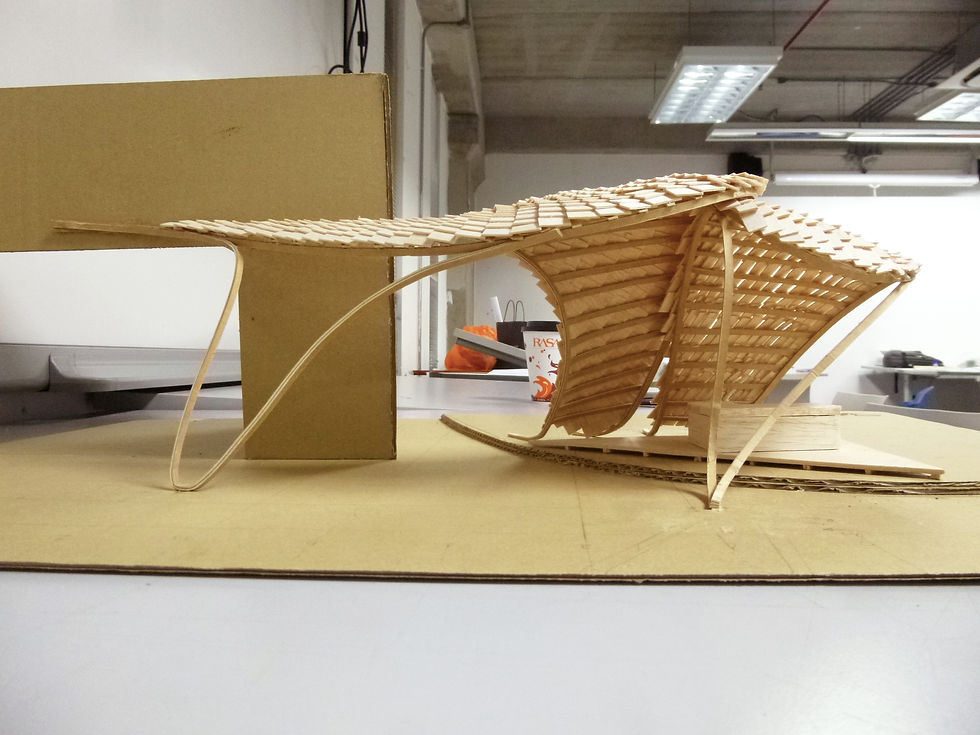
The liveliness and movements of the crowd around the site and the smooth streamline of the fish has inspired the initial concept of dynamism for the shelter. The shelter functions as a hub to provide info on events in CODA and as a shelter for students who waits in the area.
Extending out from CODA, we want to create a visual connection with the gallery, as well an effort to create an indirect circulation to the gallery itself. A glass will be installed a the back fin right in front of the gallery entrance allowing students who enter the commercial block aware of the events going on.
The curved roof is to shed the rain with the sides curve downwards in such angle to prevent too much rainwater from entering the shelter. The extension from CODA also acts as a pathway into the commercial block during rainy days as to the overly high existing roof at that area that does little protection when the rain is heavy. The elevated floor level using wooden pallets that are seen in the university is to ensure the users can always keep their feet dry because the site itself are always pooling with water.
Our group strived to create a shelter that is welcoming and easily accessible, thus the open concept, while allowing ventilation to occur. This also allows a wide view for students to observe if their cars have arrived. Meanwhile, the covered side of the shelter protects the users from the hot afternoon to evening sun, with a slit in the middle for the evening sunset to shine right through it. The scale-like timber shingles we are using for the overall facade, due to its thermal properties, are able to prevent the inside of the shelter from being overly heated. The overlapping shingles create different gradient of light in the space, with the wavy form to produce a poeticness of the space itself.
Overall, the shelter with sustainability in mind, is to give an sense of security and comfortable in order to attract users in the same time acting as an attraction point for CODA gallery even for drivers who pass by it.
Class analysis boards on site @Belum
 |  |
|---|---|
 |  |
 |  |
 |  |


Project 2 Nature Appreciation Center(NAC)
List of buildings referred:
Reclaimed Telegraph House Langkawi (WHBC Architects)
Wild Turkey Bourbon Visitor Center (De Leon & Primmer Architecture Workshop)
This project calls for a simple public building that integrates the complexity of site topography and vegetation and strategies for sustainable design.
Situated at the end of a cape on Pulau Banding, the site has a few existing orang asli mock up houses, surrounded by tall trees and the Temenggor lake. Due to its location, the site has the potential to act as a jetty point into the Royal Belum Statepark while being a centre for visitors to appreciate the nature and beauty of such rainforest as old as 130millions years.
On my visit there, I was deeply attracted by the ripples of the lake and the trees which scattered around in the middle of the lake. The trees are there due to the fact the forest was flooded by the dam water, now it became one of the attraction points for those who takes a tour in the statepark. This resulted in the derival of my NAC's concept from the movement of the water and the tree.
The concept of the NAC is shown through the movement of the circulation itself, like the ripples, all the main circulation paths intersect at the central tower, which represents the tree. Besides skylight are used to increase daylighting as parts of the site have dense foliage. Moreover, an interaction between the external and internal surrounding is allowed. Shadows of leaves will be casted in the spaces, same as the reflections of water during rainy days, creating a movement that comes from the surrounding context.
The use of traditional pitch roof with nipah thatched onto it is due to it being locally abundant and the quality of the leaves that produces soothing sounds and layers of colors at the tip of the leaves. Rammed earth, bamboos and timber are widely used in the NAC to create a more close to earth feeling for the visitors, especially through senses such as touch, smell and visual. Hence the materials are used on pathways, columns, seatings and railings.
Besides the exhibition area, all spaces are open or semi-open for ventilation and to prevent the separation of visitors from the surrounding. Even though the exhibition area are closed, but transparent sliding glass are used to merge the surrounding into the space.
The central of the NAC stands the tower, acting as an alternative path down to the second gallery and also a way for visitors to get to the top to enjoy a full view of the area with overlapping hills covered in mist and lush green forest. One of the purpose of the tower is also to create an overwhelming sense in the visitors with its prominent existence. The intention is to create an emotional response in the visitors, making them aware of the mightiness of Nature and how tiny human are compared to it. The gaps in between the bamboo claddings allows the penetration of sunlight into the tower, creating a visual experience that changes throughout the day. (Inspired by Liyuan Library)
On the first floor, there is an "experience pathway" connecting the building space to the tower. Suspended off the ground, this narrow path is to allow more solitary moment for the visitors, as human are able to appreciate something more when they are by themselves. (Inspired by the walkway in Wild Turkey Borbon Visitor Center)
Exiting from the tower, there will be a rock experience space, with rocks found during excavation, enabling visitors and children to interact with it, strengthening the experience with Nature.
In conclusion, through this design, I intended to create a NAC that merge with its surrounding context while being able to heighten the awareness and senses of visitors towards Nature, allowing them to appreciate the beauty of it by experiencing the different spaces in the NAC.